Fusion-Driven Plasma Propulsion
The same confinement core that powers a city is redirected into a magnetic nozzle, expelling shaped plasma for continuous thrust.
Section VII · Voyager-Class Cores
The Radiant Core as a starship engine — fusion plasma thrust, quantum synchronization, cryogenic channels, Voyager-class cores, and relay-linked navigation across the frontier.
The Voyager-class core is a Radiant Core turned outward. The energy that lights a world becomes the thrust that crosses the dark between them.
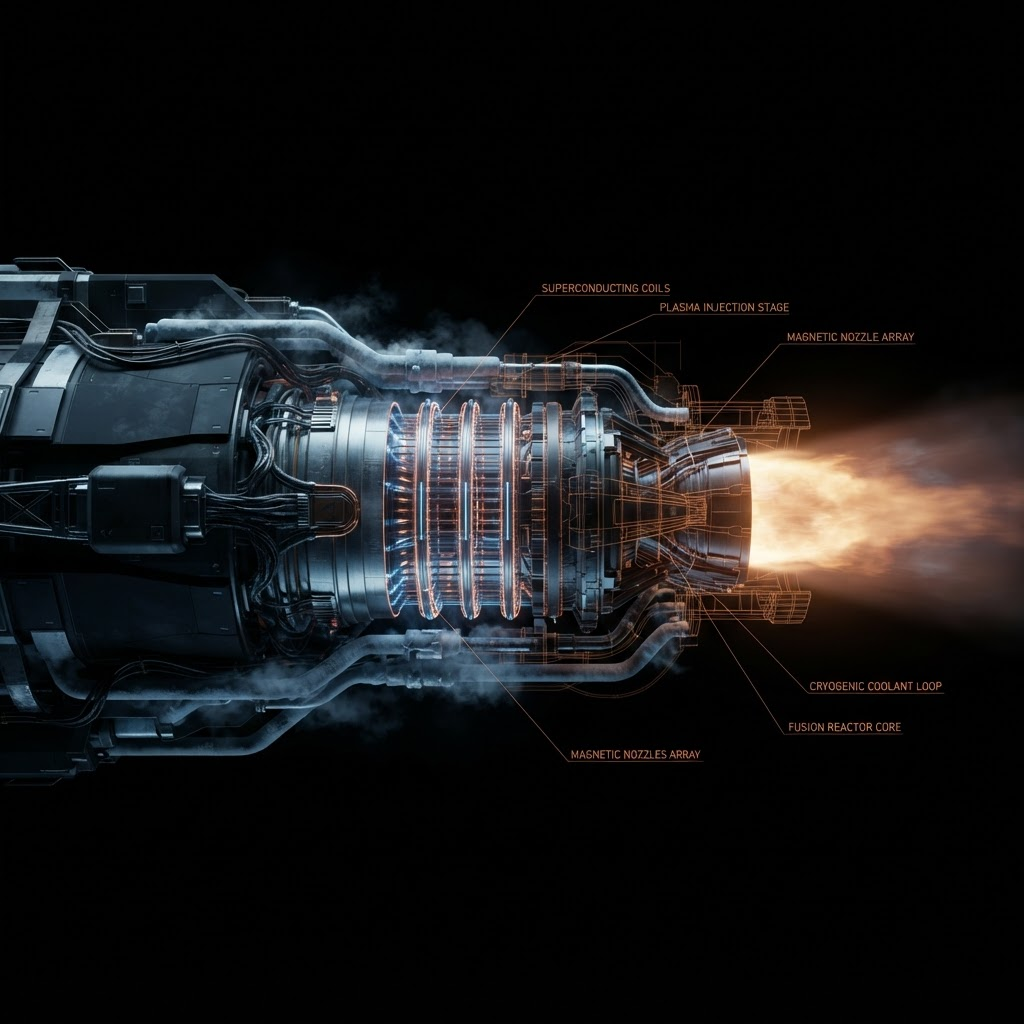 RC-Voyager · Magnetic Nozzle Assembly
Specific impulse
18,500 s
Exhaust velocity class
Continuous thrust
4.2 MN
Sustained burn rating
Burn endurance
12 years
Single fuel provisioning
Reliability
99.997%
Deep-space certified
The same confinement core that powers a city is redirected into a magnetic nozzle, expelling shaped plasma for continuous thrust.
Phase-locked control trims exhaust velocity in real time, holding precise acceleration across a decade-long burn.
Superconducting thrust channels steer the plasma stream without physical contact, eliminating erosion at the throat.
Layered shielding rings protect crew and lattice from neutron flux during sustained high-output operation.
Closed recovery loops recapture exhaust heat and stray radiation, extending range far beyond a single fuel load.
Emergency deceleration and inertial damping bring a Voyager-class core to a controlled stop at any point in transit.
Every Voyager-class drive is a node in the network — synchronized with relay stations and navigation beacons, drawing on deep-space reliability protocols so that no ship, however far from home, travels without the Empire's power behind it.